During the CHECKPOINT project, Border Crossings assembled and catalogued its physical and digital archives, as well as assembling a new archive of Oral Histories. The Resources pages that follow offer specific ways to navigate and use these archives. This page is more open and discursive, offering wider frameworks within which students can think, talk and write about the archive and its roles. Teachers can use the Resources on this page to stimulate conversations in the classroom, either leading students towards more practical interactions with the archive, or to place work they have already done in a wider context, and to help them theorise their performances.
- Why do theatre companies assemble archives?
- Britain's Association of Performing Arts Collections offers this list of reasons for archiving a theatre company's records, and guidance on how to do it.
- This web page from the American Theatre Archive Project suggests some basic reasons for archiving. They also publish this much larger digital manual.
- This article from the Kathamandu Post suggests some other reasons for archiving, which apply in Nepal. Think about whether archives have a different function for theatre companies in non-Western cultures, and if so, why. How might these considerations affect a company like Border Crossings, which works internationally and engages with different cultures?
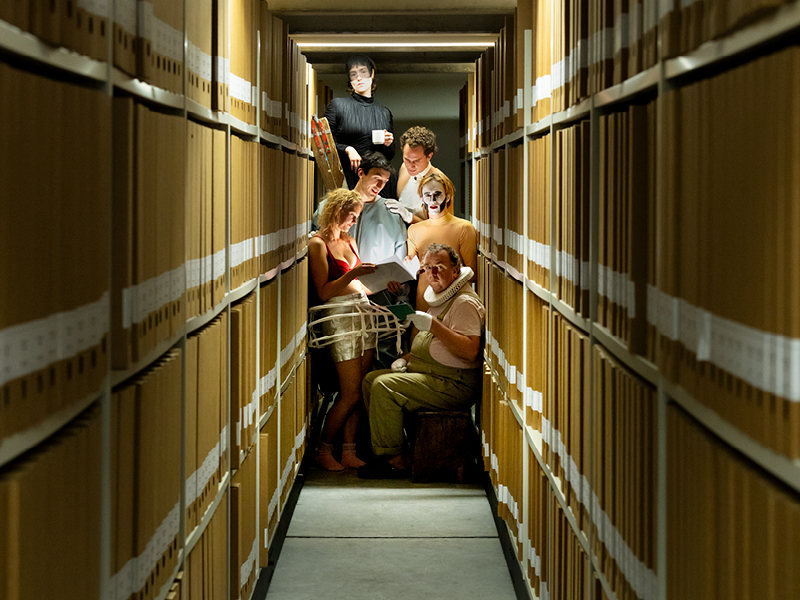
The Border Crossings archive is housed in the Theatre Collection at the University of Bristol. This video shows that the Collection doesn't just include documents and records, but makes use of other items to bring students and scholars closer to past performances.
- How do digital archives differ from physical ones, and how can we use them?
- Physical documents, for example programmes, posters, prompt books, reviews, even photographs, can offer traces of a performance that has happened in the past. The Bristol collection also includes costumes and props, which certainly give a sense of what the show may have been like. How far do you think these traces can help you understand what it felt like to be at a performance?
Digital records, particularly videos, can help to preserve the look, pacing and emotional energy of a performance. In some ways, an archive video can give you the feel of watching the original performance. Think about what makes the two experiences different. Is it a good thing that we now have video archives?
"Donald Sinden: If you take some of John Gielgud's recordings of the 1930s, they seem dated today... It's a question of style and period, isn't it? I mean, I can't believe that one of Ainley was done in 1938. I'm sure it's older than that.
Peggy Ashcroft: Well, he might have been lured into a studio, mightn't he? And done a rather ham version of that speech.
DS: I remember hearing him during the war on the radio, doing Les Misérables. It was really over the top. With so many of those older actors it's unfortunate in a way that they're recorded.
PA: I think it's very unfortunate that any of us are recorded."
(Conversation from TV series, transcribed in Barton, John: Playing Shakespeare. London, Methuen 1984 p.208)
During the CHECKPOINT project, Border Crossings' digital archives were treated as a resource for students to respond to, making new devised performances which the archived work suggested to them. This video shows how that process worked out in practice.
Think about these quotes from scholars working around digital performance archives:
"The enduring form of digital documents creates a manifold afterlife for performance on the Web, which is the home of an evolving network of people who connect to each other through their re-interpretation of the... Legacy. I am arguing that the life of a performance does not end over a fixed duration, but is instead a dialogic process with a multitude of access points."
(Dunne-Howrie, Joseph: Regenerating the Live: The Archive as the Genesis of a Performance Practice. Lincoln University PhD thesis 2015 p.4)
"Performances in, with, and of the archive are producing an ontological change – from the archive as a repository of documents to the archive as a dynamic and generative production tool."
(Osthoff, Simone: Performing the Archive: The Transformation of the Archive in Contemporary Art from Repository of Documents to Art Medium. Edited by Wolfgang Schirmacher. New York: Atropos Press 2009)
"The archive is a very potent space of dialogue with people who came before, where your vision becomes part of a larger vision."
(Peter Sellars - Theatre Director, Special Professor at UCLA and Patron of Border Crossings)
"Degrees of ephemerality in documentary transmission may, paradoxically, have the potential to resuscitate something of the ‘live’."
(Kershaw, Baz: Performance as Research: Live Events and Documents’, The Cambridge Companion to Performance Studies. Cambridge: Cambridge University Press, 2009 p.42)
"An archival mode of practice emerges when live performance’s potential to remain, rather than its propensity to disappear, is used as the basis to formulate an ontological ‘truth’ of performance."
(Dunne-Howrie, Joseph: Regenerating the Live: The Archive as the Genesis of a Performance Practice. Lincoln University PhD thesis 2015 p.59)
Discuss how these ideas might inform your work in response to archived performances.
What is an Oral History archive and why does it matter?
The Border Crossings Oral History archive can be navigated using Part 2 of these Resources. There are several different ways in which the archive might be used:
People who have worked with a theatre company can give us a sense of what their work involves, what training or qualifications they may have needed to do it, and how it may evolve and develop in different cultural or working contexts.
People who have been involved in artistic projects complement other records of those projects by telling us what it meant for them. An archive, it has been said, should aim to capture “not just the fact but the experience of the work… thoughts and feelings over facts and figures”.
(Alban, David - Senior Archivist at Rambert, speaking at an archiving workshop at the National Theatre, January 2025)
What sort of archives have other theatre companies assembled?
Here are some links to other online theatre archives, to give students some points of comparison. In each case, you can ask "How is this archive similar to the Border Crossings one, and how is it different? What do these similarities and differences tell us about the different organisations? How does this affect our understanding of what archives are and what they might be for?"
The Druid Theatre Digital Performance Archive
New Earth Theatre Living Archive
Tara Arts Archive (within the South Asian Diaspora Arts Archive)
Resources 2: Interviews with people who have worked with us since 1995