

Angelo Mikhaeil - London FLO ****
For a long while I have said that it is a time for telling old stories in new ways, which is why I was eager to catch SUPPLIANTS OF SYRIA, a play conceived and directed by Michael Walling. It is a reimagining of one of the earliest plays ever written, Aeschylus' SUPPLIANTS. This story, like the ancient one, is concerned with war, refugees, and women's plight within these man-made blights. The play begins by telling us that theatre held a central part in Greek democracy. Drama was a way that the ancients confronted political ideas of the time, and participation was a way for citizens to exercise their civic duty. The actors duly remind us that the citizens of Athens only included men and not women, slaves, or foreigners. This is just one way in which the nature of democracy and our societies have changed since then. A speech from Albert Camus comes to mind, in which he spoke of the place of art the in modern societies he deems increasingly artificial. “Is there anything surprising in the fact that such a society asked art to be, not an instrument of liberation, but an inconsequential exercise and a mere entertainment?”
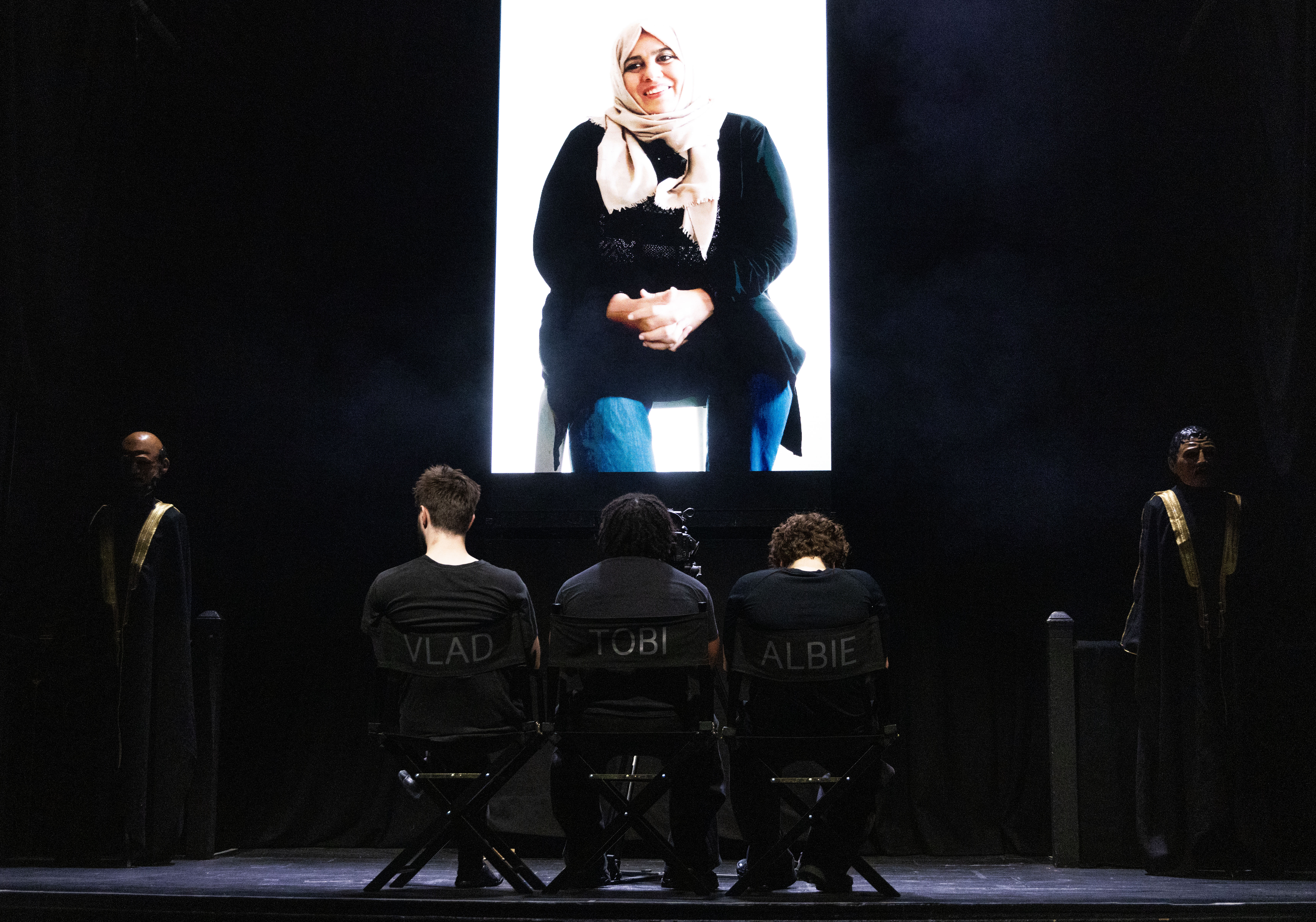
Through filmed testimony, poetry, music and movement, SUPPLIANTS OF SYRIA reiterates this sentiment through its themes and its form. It is beyond “mere entertainment.” It is stark and it is uncomfortable. The Syrian women tell anecdotes of seeing headless bodies, of giving birth in a hospital that is being bombed and abandoned by the doctors, of witnessing the pain and suffering that is common to those who are displaced by war. These women on film comprise the chorus of the play, mirroring the Danaids from the original. The director flew to Turkey to film them, and their presence remains on the screen throughout, above the actors on stage, moving in slow motion, reminding the audience that they are the protagonists of this story which is being told by others. Walling’s script represents a reflective meta-commentary on the production of the play. An actor wonders aloud whether the director felt better, seeing the women in front of him through the lens of his camera. The actors, Tobi King Bakare, Vlad Gurdis and Albie Marber, are playing themselves. Helping to devise their characters, their performance was sincere, energetic, and delivered with the cynicism and irony a script like this requires. Together they question the ethics of performing in such a play: one of them, on the phone to his agent, is not sure he wants the job, and uses the term "grief-jacker" in reference to the director. Another, speaking to his mother, wonders if it is right to be telling the stories of these refugees to an audience that looks nothing like them. Again, Camus’ speech comes to mind: “Until now the artist was on the sidelines. He used to sing purposefully, for his own sake, or at best to encourage the martyr and make the lion forget his appetite. But now the artist is in the amphitheatre…”
Creation of such earnestly political art may well drop an artist into the battlefield of our culture wars, with the politico-social arena being the amphitheatre where the public clashes over the values, identity, and social norms that shape politics, media, and everyday conversation. This play outright embraces its function as part of a wider democratic process, not hiding behind subtlety. It is a piece of art that is not afraid to ask questions of itself. The script acknowledges that some may agree with its self-criticism that the work is “grief-jacking.” From my perspective, I appreciate storytellers who want to amplify the voices of those who go unheard. An underlying truth is that both democracy and art are uncomfortable because reality is uncomfortable. Art can be our greatest escape from this reality, but it can also be a way of liberating us from it. I hope that these women have some sense of this liberty through sharing their stories through this project. For those in the audience who are safe at home in London, I guess we must sit with the discomfort of not knowing if they ever will feel the freedom of having somewhere to belong, and the unease of knowing that these crises and the politics behind them continues. SUPPLIANTS OF SYRIA was impactful theatre. It was necessary theatre. I leave disturbed, but with heightened senses awoken from a recent complacency. Hearing the voices and stories of others remind us that democracy is not just an empty ideal, and that listening to others is in fact the very first democratic act.
Piotr Kozak - Exiled Ink
‘No one leaves home unless home is the mouth of a shark,’ wrote the Somali-British poet Warsan Shire in Home. In the multimedia, interactive theatre production SUPPLIANTS OF SYRIA, we are invited to look directly into that mouth.
Created by Border Crossings — a company with more than three decades of experience in intercultural performance — the production is a collaboration with Çukurova University, the Meryem Women’s Co-operative, and Hoxton Hall. It also forms part of a wider programme of exhibitions, debate and community engagement.
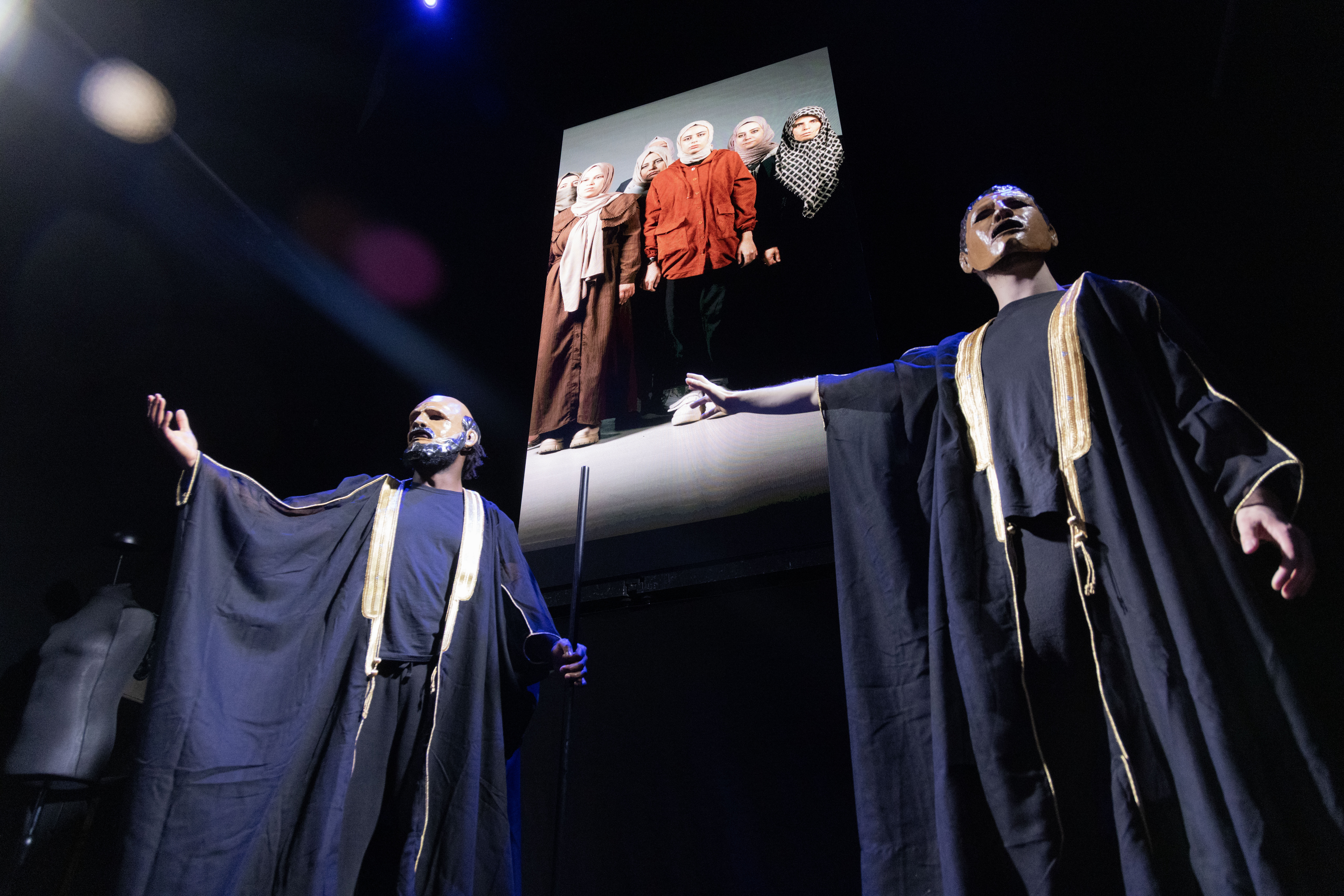
The performance reworks Aeschylus’ 463 BC tragedy SUPPLIANTS, a play about women seeking refuge, placing it in dialogue with the filmed testimonies of displaced Syrian women in Turkey, who also perform the choruses from the original play. Their testimonies and choral performances are woven into the live staging, where three actors respond to and echo their words. The venue’s walls are adorned with artwork by local refugees, extending the experience beyond the stage.
The result is ambitious and layered. Ancient text and contemporary witness sit side by side, challenging media narratives of the “refugee crisis” and foregrounding women’s lived experiences of safety, dignity and rights. The production does not allow its audience the comfort of abstraction; it insists on the human cost of war, forced migration and gendered violence.
Not all elements cohere seamlessly. At times, the transition between filmed testimony and live performance feels uneven, and the interactive audience debate midway through the evening raises complex questions that the format cannot fully resolve. Yet these moments underline the project’s experimental nature and its commitment to dialogue rather than passive spectatorship.
The most disturbing sequence incorporates footage showing preparations for an ISIS/Daesh mass execution staged in the Roman amphitheatre of Palmyra. The material is difficult to watch but underscores the brutal realities refugees flee. The images linger long after the performance ends. We also witness scenes from post-war Aleppo, filmed discreetly by the production’s artistic director, Michael Walling. A vast flea market fills the screen: hungry, displaced people selling second-hand clothes and whatever they can to survive. Equally disturbing are scenes from the Dublin anti-migrant riots, highlighting growing hostility in Western nations toward refugees and forced migrants.
SUPPLIANTS OF SYRIA is a demanding and frequently unsettling work. Its strength lies not in offering easy answers, but in creating space for voices too often marginalised in public discourse. By bringing ancient drama into conversation with contemporary testimony, it asks us to listen, to reckon with what we hear, and to respond with empathy.
Jess - Beyond the Curtain
At a time where the Overton window has shifted so far to the right, and the topic of migration and immigration is one that both the most, and the least political people are openly grappling with, this play offers a space in which to explore more facets of the argument than seems possible in its mere 1 hour 40 act. Part documentary, part play, part spoken word, this newest work from multimedia theatre company Border Crossings, offers a window into the lives of a collective of Syrian women, now settled as asylum seekers in Turkey, shrewdly intertwined with one of the earliest plays in recorded history; Aeschylus’ SUPPLIANTS.
Over a month long collaboration with a group of Syrian women, they are filmed telling their personal stories of the displacement, fear and sexual violence that women are so commonly victim to during war. These are projected onto the back of the stage, whilst on stage and reacting live to the pre-recordings were the three actor-creators (Tobi King Bakare, Vlad Gurdis, and Albie Marber). They represent the Greek chorus of Aeschylus’ play, constructing the narrative around the videoed women, subverting the traditional configuration of Greek theatre (men as the main actors, whilst women/marginalised groups play the chorus). Throughout the act, the men don the masks (a few times quite literally) of countless roles; their own selves in the audition room, Greek Gods, teenage video gamers.
Their observations are quite harrowing in parts, one woman describing hospital doctors having to evacuate midway through her c-section, returning later to finish her surgery with no anaesthetic.
Accounts such as this are tragically common amongst women in war torn environments, but the human to human telling of this story managed to reach beyond our western desensitisation to such tales. Other women spoke so eloquently and casually of their fears, lack of hope and even their own rapes, that the audience could not help but understand how much a part of their psyche these experiences had become. It was a powerful reminder that leaving an active war zone does not mean that a person is in any way safe.
After an hour of the performance, the actors opened a debate up to the audience, culminating in a democratic vote. Centring on the concept of democracy, and mirroring the fundamental plotline of the original SUPPLIANTS, we were able to discuss, after bearing witness to their change of circumstance, their total lack of control, and their yearning for safety, whether we should allow these women to enter our metaphorical land.
Almost necropolitical in nature, this powerful piece of theatre contends with an enormous number of topics; racism, feminism, war, migration, asylum, democracy, colonialism, violence against women and girls across cultures and continents, and even western waste. Where in many plays, some of these issues can feel tokenistic or underdeveloped, each theme was constructed with knowledge and sensitivity so that it was both distinguishable and meaningful, even if only briefly touched upon.
The framing of these complex subjects is purposefully disorienting, almost manipulating audiences to circumnavigate their own biases to arrive at unexpected conclusions. In one scene the audience laugh in support of an almost overbearingly patriotic Irish man as he dissects the heritage of another, before discovering that he himself is more Moldovan than Irish. We see two teenagers playing a sniper video game, the projected footage of which we learn is actual footage of a sniper attack in Aleppo. A wholesome narrative about a trip to see Blood Brothers in the West End winds its way into a confronting comparison of the Palmyra theatre massacre. There are scenes in which the creators peer around the fourth wall to demand the audience consider our own role in the interaction. Are we audience members or are we bystanders to grief and atrocity? What benefit to the women does our observation bring them? Does their happiness at having a vessel to put their stories into equate to morality on our part, or does it veer into the realms of poverty pornography?
I would absolutely recommend this play to anyone who has an interest in West Asia and North Africa (the colonial Middle East) and I commend the creators for their attempts to empower women of war. Whilst the information won’t be new to many, it’s an honour to be the recipient of these women’s chronicles and the format creates a stimulating, confronting and eye-opening piece of theatre. It was a long overdue reminder for me, that politics and art are not only the perfect pairing, but that theatre isn’t always created to be enjoyed, but experienced.


